
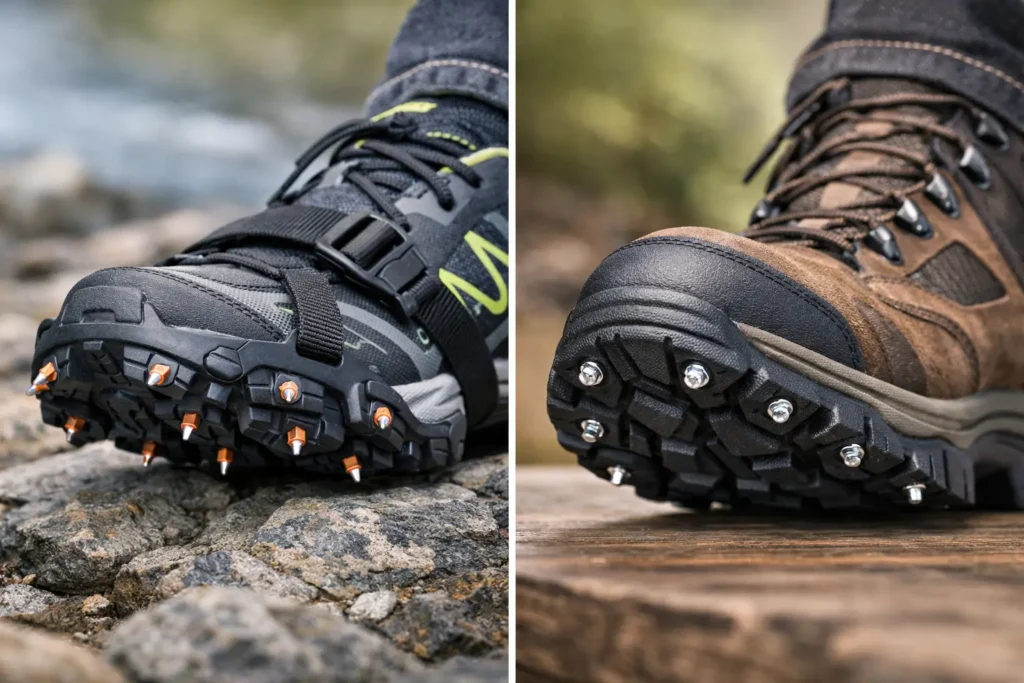
The difference between strap on cleats vs screw in spikes shows up fast – usually on the first icy step, the first slushy transition, or the first mile when your footing starts to feel awkward instead of solid. If you spend real time outside in winter, on frozen trails, slick job sites, or uneven mixed terrain, traction is not a nice extra. It is the thing that keeps you upright, moving naturally, and confident.
A lot of people start with strap-on traction because it looks simple. Pull it over your boot or running shoe, head outside, and hope for the best. That setup can work in certain situations, especially for occasional use on consistently icy surfaces. But once you ask more from your traction – better stability, less bulk, more natural movement, and reliable performance across changing terrain – the tradeoffs get hard to ignore.
Strap on cleats vs screw in spikes: the real difference
At a basic level, strap-on cleats are external devices. They wrap around your footwear with rubber harnesses, chains, coils, or molded traction plates. Screw-in spikes mount directly into the sole of the shoe or boot. That difference matters because it changes how traction feels, how securely it stays in place, and how your body moves over the ground.
Strap-on systems add a separate layer underfoot. That can create a disconnected feel, especially if the cleat shifts, stretches, or sits unevenly on the outsole. Screw-in spikes become part of the shoe itself. The traction sits where your foot already lands, which usually means a more planted stride and less fight between your footwear and the device attached to it.
That does not mean strap-ons are useless. For someone who wants temporary traction they can remove quickly, they still have a place. But for runners, hikers, workers, and anyone walking daily in winter conditions, direct-to-sole traction often feels more stable because it is more integrated.
Fit and feel underfoot
This is where many buyers decide, even if they do not realize it at first. Strap-on cleats can change the way your footwear flexes. They can create pressure points, add weight, and alter the way your foot rolls through each step. On short walks, that may be manageable. Over longer distances, it can mean fatigue, hot spots, and a gait that feels clunky instead of efficient.
Screw-in spikes usually preserve more of the original shoe feel. Your boot or running shoe still flexes the way it was built to flex. You are not stretching rubber over the upper or hanging hardware beneath the sole. You are adding bite where you need it without turning the whole shoe into a different piece of gear.
That matters for athletic users, but it matters just as much for everyday safety. Seniors, dog walkers, commuters, and outdoor workers all benefit from traction that does not fight the foot. When your stride stays natural, balance tends to improve. When balance improves, confidence follows.
Why gait disruption matters
A traction device can have aggressive grip and still be the wrong choice if it throws off your movement. Bulky systems can make you land differently, shorten your stride, or walk more cautiously than normal. That might sound minor, but over time it can wear on your hips, knees, and lower back.
A lighter, lower-profile traction setup reduces that problem. The goal is not just to stick to the ground. The goal is to move with control and less strain while you do it.
Grip on ice is only part of the story
Most traction marketing focuses on glare ice, and for good reason. Ice is where slips get dangerous fast. But many real-world conditions are mixed. You step from packed snow to wet pavement, from frozen mud to gravel, from icy shade to exposed rock. That is where the gap between strap-ons and screw-in systems gets wider.
Strap-on cleats often perform best in narrow use cases. Some are built for snow-covered sidewalks. Others do okay on flat ice. But on mixed terrain, they can feel cumbersome. Chains and coils may skate on hard surfaces or wear down quickly. Some designs also collect slush and debris, which can reduce consistency right when you need secure footing.
Screw-in spikes tend to handle terrain transitions better because they stay tight to the sole and keep the shoe profile more stable. You are not managing an accessory that shifts with every surface change. You are wearing footwear with built-in bite.
That is a big reason experienced users move away from removable over-shoe systems. They want traction that works in motion, not just traction that looks aggressive in a product photo.
Durability and day-to-day reliability
Durability is not only about how long a product lasts in storage. It is about whether it still performs after repeated use in cold, wet, dirty conditions. Strap-on cleats rely heavily on stretch materials. Rubber harnesses can loosen, crack, or snap. Chains can bend. Fit can get sloppy over time, especially if the cleat is pulled on and off often.
Screw-in spikes have their own maintenance reality. They need proper installation, and eventually some users replace worn spikes. But a direct-mount system avoids the weak points common to removable traction gear. There is no outer harness to stretch over a boot, no dangling undercarriage to shift, and no constant removal cycle beating up the product.
For people who are outside every day, reliability matters more than convenience in the package. The traction that is with you, ready, and secure usually beats the traction sitting in a truck door pocket because it is annoying to put on.
Convenience depends on how you actually use traction
This is the section where the answer becomes, it depends.
If you need traction a few times each winter for a short walk on a frozen driveway, strap-ons may feel practical. They are easy to understand, and you can remove them when you go indoors. For occasional use, that simplicity has value.
But if you run in winter, hike mixed trails, work outside, or deal with slippery conditions day after day, the convenience equation changes. Taking devices on and off gets old. So does adjusting them when they slip out of place. So does carrying something bulky because it is not comfortable enough to keep on your footwear full time.
That is where screw-in traction earns its place. It is not convenience built around temporary use. It is convenience built around being ready. For many active users, that is the better kind.
Who tends to prefer each option?
Casual users often lean toward strap-ons because they want a removable winter accessory. Performance users and daily outdoor users often prefer screw-in spikes because they want secure traction with less interference. People buying for older family members can go either way, but lower-profile traction has a strong advantage when natural walking and confidence are top priorities.
Safety is more than raw grip
The safest traction system is not always the one with the biggest-looking hardware. It is the one you will actually wear, the one that stays put, and the one that supports stable movement over the conditions you face most.
Strap-on cleats can create safety issues of their own when they shift, loosen, or change your walking mechanics. A device that moves underfoot can be distracting at best and hazardous at worst. Bulk also matters. If traction feels awkward, some users change their posture or walk stiffly, which can reduce stability.
Screw-in spikes can deliver a more secure, confidence-building feel because the traction is fixed to the sole rather than hanging off it. That integrated design is one reason direct-install systems stand out. ICESPIKE built its reputation on exactly that advantage – powerful grip without the bulk and gait disruption common with strap-on traction.
That said, no traction tool is perfect for every surface. Indoor flooring, delicate finished surfaces, and certain hard materials may still call for caution or removal. Good traction improves safety, but it does not replace awareness.
Which one should you choose?
If your winter traction needs are light, occasional, and mostly limited to predictable conditions, strap-on cleats may be enough. They are a seasonal add-on, not a performance upgrade. For some buyers, that is all they need.
If you want traction that feels lighter, more natural, and more dependable across real terrain, screw-in spikes are usually the stronger choice. They make more sense for runners who care about stride, workers who cannot afford unstable footing, hikers covering uneven ground, and everyday users who are tired of bulky gear that never feels truly secure.
The best traction should not make you feel like you are wearing a workaround. It should make you feel ready to move. When your footing is solid, you walk stronger, work safer, and spend less energy worrying about the next slick patch. That is the kind of traction people keep using long after the first snowstorm passes.