
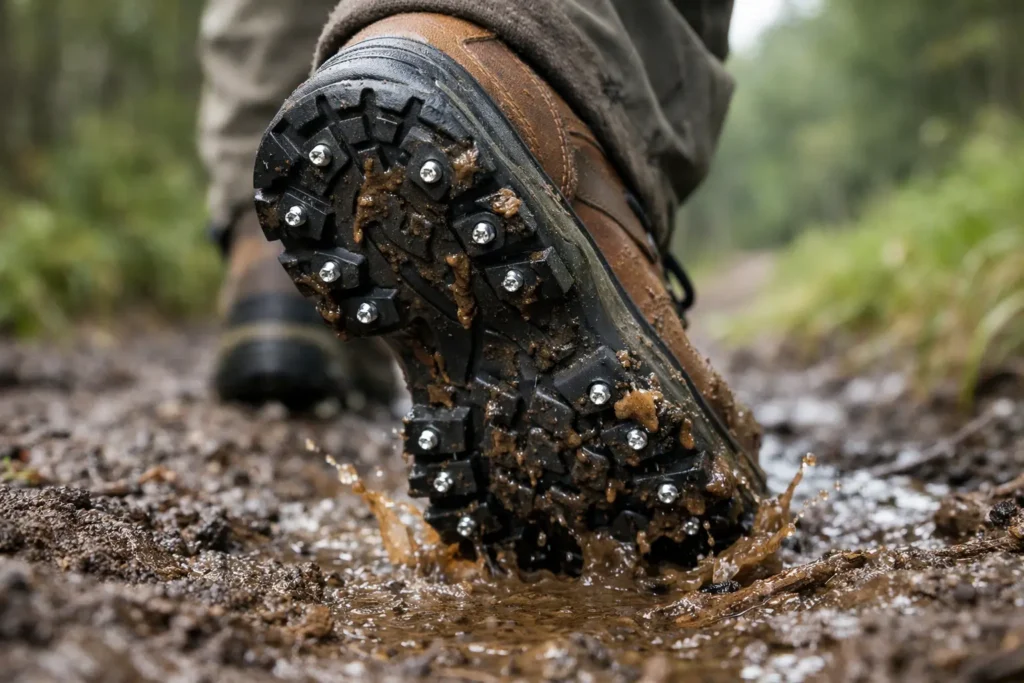
Mud changes the trail fast. One dry stretch turns into a slick climb, a root-covered descent, or a boot-sucking mess that steals balance with every step. If you need real traction for muddy trails, the goal is not just to avoid slipping. It is to keep your stride stable, your footing predictable, and your energy focused on moving forward instead of fighting the ground.
That matters more than most people think. Mud is not one surface. It can be thin and greasy over hardpack, deep and soft with no base under it, or mixed with wet leaves, slick rock, roots, and gravel. Each one challenges footwear differently. That is why some trail shoes feel great in loose dirt but skate when conditions turn wet, and why bulky traction add-ons can help in one moment and get in the way in the next.
What traction for muddy trails really depends on
Good grip in mud starts with contact and penetration. A flat sole with shallow tread tends to smear across the top layer, especially when the mud is packed and slick. A more aggressive tread can bite deeper, reach firmer ground underneath, and shed buildup instead of turning into a smooth slab.
But tread alone does not solve everything. The shape of the lugs, the spacing between them, the softness of the rubber, and the way your shoe flexes all play a role. So does your body position. If your heel is striking hard and your weight is behind you on a downhill, even decent tread can let go. If your foot lands under your center of mass and your shoe can grip without packing up, stability improves fast.
This is where people often make the wrong call. They assume more bulk means more traction. In reality, heavy strap-on devices can disrupt natural movement, shift underfoot, and create awkward contact on mixed terrain. On a muddy trail with short stretches of rock, roots, and firmer dirt, that can leave you less stable, not more.
Why muddy trails expose weak gear fast
Mud is a brutally honest test. It shows you whether your footwear works only in ideal conditions or whether it can handle the real world when the trail turns unpredictable.
Shoes with shallow, tightly packed tread usually fail first. They collect mud until the sole loses definition, and once the tread is clogged, grip drops off quickly. Road shoes are the worst match here. They are built for pavement efficiency, not soft ground, and they often slip the moment the trail gets greasy.
Traditional over-shoe traction systems have their own trade-offs. Chains, coils, and harness-style devices can add bite on certain surfaces, but mud is not always where they shine. They can hold debris, feel unstable on uneven ground, and add weight that changes the way you move. For runners, hikers, and outdoor workers who need secure footing without a clunky ride, that compromise gets old fast.
Even improvised screw shoes can be hit or miss. If the hardware is poorly placed, too aggressive, or not designed for all-surface movement, you can end up with uneven pressure, awkward gait, or reduced comfort on firmer sections of trail.
The best footwear setup for muddy trail traction
The right setup depends on how and where you move. A trail runner covering rolling singletrack needs something different from a hiker carrying a pack or a worker crossing wet ground all day. Still, the best systems share a few traits.
First, they keep weight down. Extra ounces matter when every step is lifting through sticky mud. Second, they preserve a natural gait. If the traction solution fights your stride, fatigue goes up and control goes down. Third, they perform across mixed terrain. Mud rarely appears alone, so your grip needs to stay dependable when the trail shifts from soft ground to roots, gravel, frozen patches, or hardpack.
That is why direct-to-sole traction has a clear advantage for many users. Instead of wrapping a separate device around the shoe, installable spikes become part of the footwear. The fit stays clean, the profile stays low, and the movement feels far more natural. For people who want confidence without bulk, that difference is not small. It is the whole game.
ICESPIKE was built around that idea – serious traction that works with your footwear instead of fighting it. On muddy trails, that integrated feel matters because balance comes from consistency. You want every footfall to feel planted, not tentative.
How to choose traction for muddy trails
Start with the trail, not the product. If your usual route is mostly soft, churned-up mud, a deep-lug trail shoe may be enough. If your trails mix mud with slick roots, wet wood, loose gravel, and occasional frozen ground, you need a more versatile solution. That is where many people benefit from adding low-profile traction directly to a boot or shoe they already trust.
Fit matters just as much as tread. A shoe that slides internally or feels loose in the heel will waste whatever grip you have. Your foot needs to stay locked in so the sole can do its job. A secure upper, stable platform, and predictable flex all improve traction because they improve control.
It also pays to think about duration. A short trail run after rain is one thing. Four hours on steep, muddy terrain is another. If you are out long enough for fatigue to become a factor, lighter and more integrated traction usually wins. Less drag. Less awkwardness. Less energy lost fighting your own gear.
Technique still matters on slick ground
No traction system can erase bad movement. Mud rewards control and punishes overconfidence.
On climbs, shorten your stride and keep your weight centered over your feet. Driving too hard off the toe can cause spin-out, especially in soft mud. On descents, avoid leaning back. That classic defensive posture often reduces your ability to grip because your heels hit harder and your feet slide ahead of you.
Watch the shine on the trail. Glossy mud, polished roots, and wet rock usually mean lower friction. If the trail edge has firmer texture than the center rut, use it. If the mud is deep enough to hide the base, expect inconsistent footing and place each step with intent.
Poles can help hikers, but they are not a substitute for underfoot traction. They add balance points, not grip at the shoe. If your footwear is wrong for the terrain, you will still feel every slip.
When more aggressive traction is worth it
Some people only need occasional extra bite after a storm. Others deal with mud for months at a time. If you run, hike, work, or walk outdoors through shoulder season and winter, stronger traction stops being a luxury. It becomes a safety tool.
This is especially true for older adults, workers carrying loads, and anyone moving on uneven ground where one slip can mean more than a dirty pant leg. A fall on muddy terrain can twist a knee, strain an ankle, or send you into rock or timber. Secure footing is not about looking tough. It is about staying upright and staying moving.
The smartest choice is usually the one you will actually keep using. If a traction device is bulky, annoying to put on, or uncomfortable on mixed surfaces, it often gets left behind. A lighter, lower-profile system has a better chance of becoming part of your everyday setup, which means you get the benefit when conditions turn bad without having to rethink your gear every time.
Common mistakes that ruin muddy trail grip
One mistake is assuming any outdoor shoe is a trail shoe. Another is waiting until the sole is worn smooth before replacing or upgrading footwear. A third is picking traction based only on the worst surface, then suffering through the rest of the route with something too clunky for normal movement.
There is also a tendency to treat traction like an all-or-nothing problem. It is not. The best setups balance bite, comfort, stability, and versatility. You need enough grip to handle the slick sections without giving up efficiency everywhere else.
That balance is what separates gear that feels good in the garage from gear that proves itself on the trail.
If muddy trails are part of your routine, do not settle for slipping, overstriding, or dragging around bulky hardware that changes how you move. Choose traction that grips hard, stays out of your way, and keeps your footing natural from the first wet step to the last climb back to the trailhead. Confidence starts underfoot.