
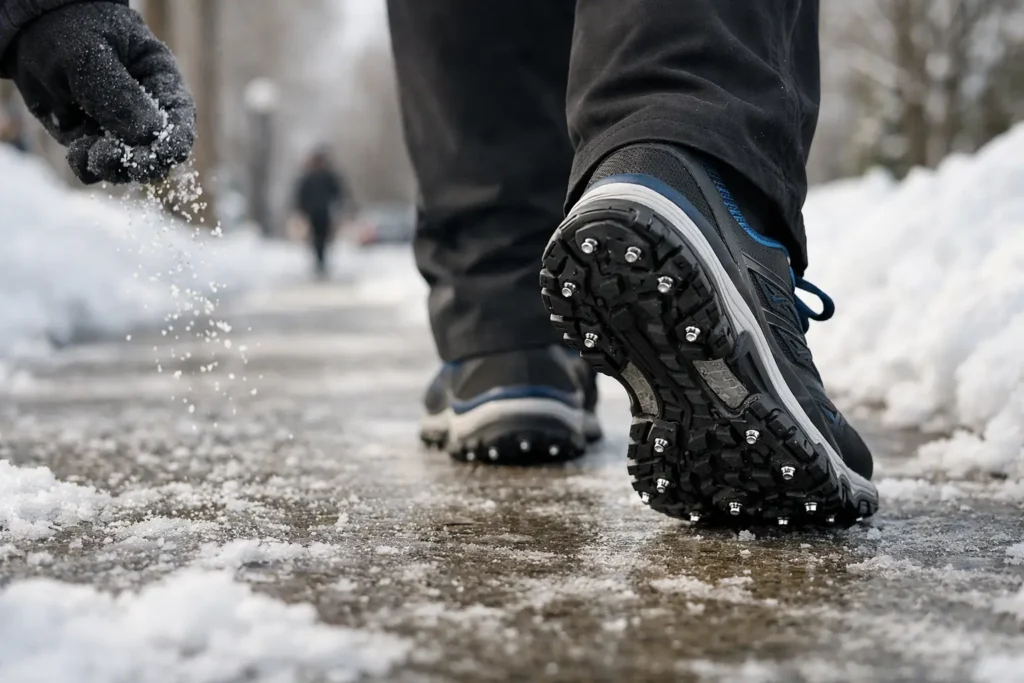
A snowy sidewalk can look harmless right up until your foot shoots forward and the rest of you tries to catch up. That is why knowing how to prevent slips on snowy sidewalks matters long before the first close call. Whether you are walking the dog, heading to work, checking the mail, or putting in miles on a winter run, traction is not a nice extra. It is the difference between moving with confidence and bracing for impact.
Most winter falls do not happen because people are careless. They happen because the surface changes faster than your body can react. Packed snow turns to glaze ice. A shoveled path still hides slick spots. Slush refreezes overnight and leaves a thin, hard layer that looks like wet concrete until you step on it. If you want fewer slips, you need a system, not luck.
How to prevent slips on snowy sidewalks starts with traction
The biggest mistake people make is treating winter footing like a walking technique problem when it is really a traction problem first. Yes, how you move matters. But if your shoes cannot grip the surface, even perfect posture has limits.
Smooth outsoles, worn tread, and casual winter shoes with shallow patterns struggle on snow and ice. They may feel fine in dry conditions, but once the ground gets slick, they stop giving you the bite you need. That is when people start shortening their stride, stiffening up, and walking cautiously, which can help a little, but it does not solve the core issue.
Real traction comes from contact that can actually engage the surface. On packed snow, aggressive tread helps. On ice, tread alone is often not enough. That is where dedicated traction hardware changes the game. Low-profile traction spikes installed directly into the sole can provide a more secure, natural-feeling grip than bulky strap-on systems that shift, loosen, or interfere with your gait. For active adults, outdoor workers, and anyone who spends serious time moving outside in winter, that difference is not small. It is the difference between tentative movement and confident footing.
The footwear choice that makes winter safer
If you want to know how to prevent slips on snowy sidewalks in everyday life, start by looking down. Your footwear is doing most of the work.
A good winter shoe or boot should fit securely, support a normal stride, and offer a sole that can handle mixed surfaces. That last part matters because sidewalks are rarely consistent. You might move from dry pavement to slush, from slush to packed snow, and from packed snow to a polished icy patch in the shade, all in one block. Heavy, awkward traction gear can make that transition harder by changing the way you walk.
This is where integrated traction stands out. Instead of pulling an over-shoe device on and off or dealing with chains and coils that feel clunky underfoot, direct-to-sole spikes keep the shoe moving naturally while adding grip where it counts. That means less bulk, less shifting, and less fatigue. If you are walking a short driveway, that may sound like a detail. If you are covering neighborhoods, job sites, trails, parking lots, or city sidewalks every day, it becomes a serious performance and safety advantage.
There is a trade-off, though. No traction setup is perfect for every indoor and outdoor transition. If you will be going in and out of delicate indoor flooring often, you need to think about when and where traction belongs. The right setup depends on your routine, the surfaces you cross, and how much winter exposure you actually have.
Replace worn-out shoes before winter proves the point
A lot of slips start with shoes that are already past their prime. If the tread is rounded off, flattened, or unevenly worn, grip drops fast. People often wait until the shoe looks obviously beat up, but winter surfaces expose traction problems early. If your go-to shoes already skate a little on wet pavement, they will not suddenly become reliable on icy sidewalks.
Match the shoe to the job
Someone carrying tools across a frozen job site needs a different traction standard than someone taking a short walk to the corner store. A runner dealing with snow-packed sidewalks needs something lighter and more natural underfoot than a heavy overshoe device. Seniors often need maximum stability with minimal fuss. The best solution depends on how you move, not just the weather report.
Walking technique still matters on snow and ice
Once traction is handled, movement becomes the second layer of defense. This is where people can reduce risk without turning every walk into a slow-motion shuffle.
Keep your steps shorter than usual and place your feet more directly under your center of mass. That gives you a better chance of staying balanced if the surface gives way. Slightly bend your knees and avoid locking your posture. A rigid body is slower to recover from a slip.
Your hands matter too. If they are buried in pockets, you lose a key balance tool. Keep your arms free when sidewalks are slick, especially on curbs, driveways, and uneven pavement. If you are carrying bags, try to keep the load balanced rather than heavy on one side.
Speed is another factor. People rush most in places they think are safe, like their own front walk or the path from the parking lot to the office entrance. That false confidence causes a lot of falls. Snowy sidewalks reward steady movement, not quick movement.
Sidewalk conditions change block by block
One reason winter walking is tricky is that the danger is inconsistent. A sidewalk may be clear in direct sun and slick as glass in the shade. Meltwater from a roofline can run across a path and freeze into an invisible strip. Foot traffic can compact light snow into a hard, polished layer that behaves more like ice than snow.
Pay attention to the areas where conditions usually get worse. Intersections, curb cuts, sloped driveways, bus stops, and entrances tend to collect packed snow and refrozen slush. Those are the places where traction gets tested hardest.
If you are responsible for the property, the timing of snow removal matters as much as the removal itself. Fresh snow is easier to clear before it gets packed down. Once people walk over it or a thaw-freeze cycle hits, the surface becomes harder, slicker, and tougher to manage. Shoveling early, spreading the right de-icing material, and checking for refreeze later in the day all cut risk.
Still, even a well-maintained sidewalk can surprise you. That is why surface awareness and proper traction need to work together.
Common mistakes that lead to winter falls
People often rely on habits that feel practical but do not hold up in real conditions. One is assuming any winter boot is automatically slip-resistant. Plenty of boots are warm and weatherproof without offering serious grip on ice. Another is trusting removable traction devices that shift around underfoot, especially during longer walks or mixed-terrain use.
There is also the old improvised screw-shoe approach. It can seem like a quick fix, but it is often inconsistent, uncomfortable, and not built for durability or balanced placement. If traction is uneven, your foot strike changes. If your gait changes, fatigue and instability follow. Better grip should help you move naturally, not force you to fight your own footwear.
A final mistake is waiting until after a fall to upgrade. Winter traction should be planned like tires on a truck. You do it before the conditions punish you, not after.
How to prevent slips on snowy sidewalks in real daily use
For most people, prevention comes down to stacking the odds in your favor. Wear footwear with real grip. Add traction hardware when snow and ice are regular parts of your day. Walk with shorter, controlled steps. Keep your hands free. Slow down in the places where polished ice tends to hide.
If you spend a lot of time outdoors, choose a traction setup you will actually keep using. That means something durable, low-bulk, and secure enough to handle daily miles without making every step feel awkward. This is exactly why brands like ICESPIKE have pushed beyond old strap-on designs. People want traction that works hard without getting in the way.
The goal is not to walk scared all winter. It is to move like you belong outside, because with the right footing, you do.
Winter sidewalks do not have to dictate how carefully you live. Build your grip first, trust gear that keeps your stride natural, and let confidence come from traction you can feel on every step.