
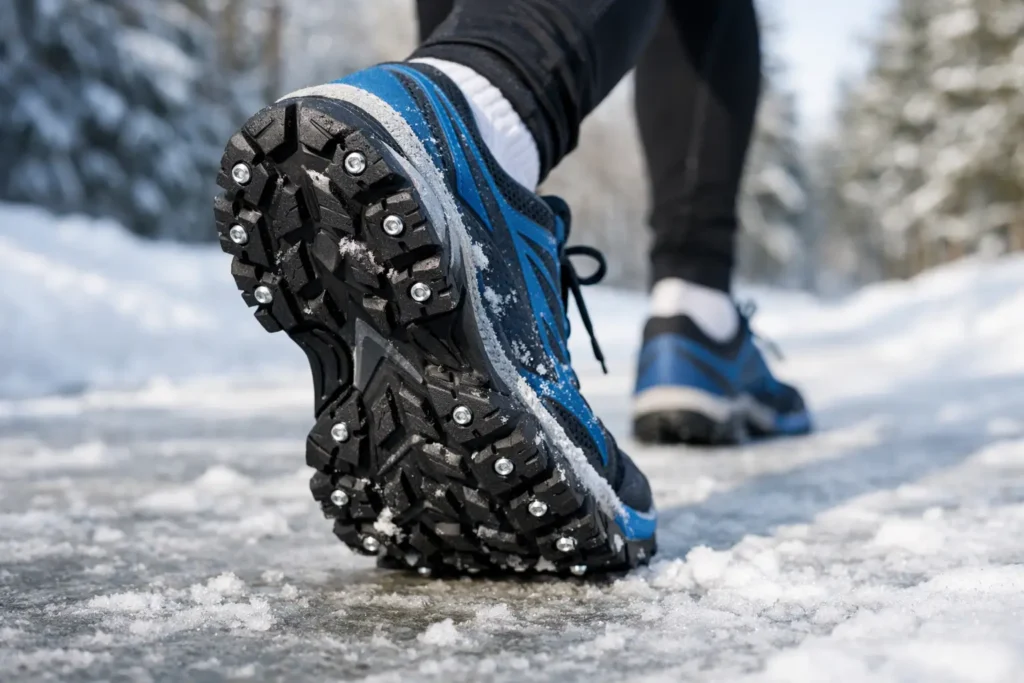
The moment your foot lands on a thin glaze of black ice, every marketing claim about grip gets tested fast. Winter running shoe traction is not a nice extra when roads harden, trails freeze, and packed snow turns slick. It is the difference between running with confidence and spending every stride bracing for a fall.
A lot of runners learn this the hard way. A shoe that feels quick and planted in dry conditions can become unpredictable the second the surface changes. Cold rubber stiffens. Tread fills with slush. Hard-packed snow behaves nothing like powder, and ice does not care how expensive your shoes were. If you run outside through real winter, traction has to be treated like performance gear and safety gear at the same time.
What winter running shoe traction actually means
Traction is not one thing. On winter surfaces, it comes from a combination of outsole rubber, lug shape, lug depth, flexibility, contact with the ground, and whether the shoe has any kind of added bite for ice. That last part matters more than many runners expect.
On snow, decent tread can help a lot. Lugs can claw into soft or uneven surfaces and give you a better push-off. On wet pavement, sticky rubber and a stable platform matter. But on true ice, especially smooth ice, traditional outsole tread reaches its limit quickly. Rubber can only do so much when the surface underneath is hard, slick, and nearly frictionless.
That is why winter traction should always be judged by the terrain you actually run on, not by the label on the box. If your route is mostly plowed sidewalks with occasional frozen patches, your needs are different from someone running icy trails, frozen parking lots, or mixed terrain that shifts from pavement to snow to glare ice in a single mile.
Why many winter running shoes still slip
A winter-specific upper can keep your feet warmer and drier, but that does not guarantee secure footing. Many winterized shoes focus heavily on water resistance, insulation, and debris protection. Those are useful features. They just do not solve the traction problem on their own.
Rubber compounds often get firmer in freezing temperatures. As they stiffen, they can lose some of the grip they had in milder weather. Tread patterns can help on loose snow, but once snow compresses into a slick layer, the edges stop doing much. If you have ever felt stable on fresh snow and then nearly gone down on the same path after it was packed by foot traffic, you have felt that limit.
This is also where runners get frustrated with broad claims about all-terrain performance. Mixed winter terrain is demanding because no single outsole design dominates every condition. Deep lugs that feel great in slush can feel awkward on cleared pavement. Softer compounds may grip better but wear faster. Aggressive trail shoes can help off-road but still skate on ice.
The difference between snow grip and ice grip
This is the key distinction that gets overlooked. Snow grip and ice grip are not the same problem.
On soft snow, traction comes from surface penetration and mechanical bite. Lugs can sink in, hold, and release. On hard ice, there is almost nothing for the shoe to deform around or dig into. That is why a shoe that feels secure on a snowy shoulder can suddenly lose control when you cross a frozen intersection.
If your winter runs regularly include real ice, you need something that bites into that surface rather than just pressing against it. That usually means some form of metal traction. It is a practical reality, not overkill.
Winter running shoe traction options
Most runners end up choosing between three approaches. The first is to rely on the shoe alone. This can work if your route is mostly wet pavement, light snow, or occasional winter debris. It is the simplest option, and it preserves the natural feel of the shoe. The downside is obvious – when ice shows up, you are asking rubber to do a job it was never built to do.
The second option is a strap-on traction device. These can add bite, especially for walking and slower movement, but they often come with trade-offs that runners feel right away. Bulk underfoot changes the ride. Added weight can increase fatigue. Some designs shift on the shoe, slap the ground, or create an awkward gait on mixed surfaces. For runners who care about rhythm, turnover, and a natural stride, that matters.
The third option is direct-to-sole metal traction. This approach gives the outsole actual points of bite without wrapping the shoe in a harness or adding the clunky feel of chains and coils. For runners dealing with recurring ice, it is often the most secure way to keep the shoe moving naturally while upgrading grip where rubber falls short. That is the advantage ICESPIKE was built around – real traction, low bulk, and a more integrated feel underfoot.
What to look for in winter running shoe traction
Start with honesty about your conditions. If you run before sunrise, after storms, on untreated roads, or on trails that freeze and thaw, you should be choosing for the worst surface you expect, not the best one.
Look closely at outsole design, but do not stop there. Lug depth helps in loose snow and mud, while a broad, stable contact patch can feel more predictable on variable terrain. A shoe that stays flexible in the cold usually feels more sure-footed than one that turns stiff and blocky. Fit matters too. If your foot slides inside the shoe, the outsole cannot do its job well.
Then ask the harder question: will this setup hold on ice? If the answer is maybe, that is not much of an answer. Winter falls happen fast, and they are expensive in every sense. Lost training time, bruises, sprains, broken confidence – that is the real cost of weak traction.
Gait matters more than people think
One of the biggest mistakes in winter traction is focusing only on grip and ignoring movement. A traction system can have plenty of bite and still feel terrible if it changes how you run.
Heavy, awkward devices tend to pull runners out of their natural mechanics. That can mean shorter strides, uneven foot placement, extra tension through the hips, and more fatigue over distance. You are not just fighting the weather at that point. You are fighting your own gear.
Good winter running shoe traction should make you feel more stable without making you feel mechanical. You want secure foot placement, not a clunky platform. You want confidence at push-off, not something that forces you to tiptoe. The best setup is the one that lets you run like a runner, not shuffle like you are crossing a frozen driveway in borrowed boots.
Matching traction to your winter route
Urban runners often deal with the most deceptive terrain. Cleared sidewalks, crosswalks, shaded corners, parking lot runoff, and black ice can all show up in one run. In those conditions, a pure trail outsole may not be enough, and bulky add-ons can feel miserable on pavement.
Trail runners face a different mix. Packed snow, frozen dirt, slick roots, rutted slush, and hidden ice demand both adaptability and bite. A treaded shoe helps, but real ice sections still call for more than rubber.
For runners who mix training with daily life, there is another factor: convenience. If traction only works when you stop, strap something on, then take it off again for every dry stretch, it often ends up left at home. That is not a small issue. The best traction system is the one you will actually use when conditions turn bad.
When more traction is worth it
Not every cold-weather run requires metal underfoot. If roads are merely wet, if snow is soft and fresh, or if your route is consistently maintained, a well-designed outsole may be enough. But the moment your route includes repeated ice exposure, frozen hills, or unpredictable refreeze, you are in a different category.
That is where adding bite stops being a luxury and starts being common sense. More grip can mean stronger push-offs, cleaner cornering, steadier descents, and less mental tension every time the ground changes color. It also means less energy wasted trying not to slip.
Confidence is performance. When you trust your footing, you run better. You stop hesitating. You stop overcorrecting. You stop turning every slick patch into a negotiation.
The smart way to think about winter traction
Do not ask whether a shoe is marketed for winter. Ask whether it can handle your version of winter. Those are not always the same thing.
For some runners, that means a capable cold-weather shoe with solid tread. For others, especially anyone dealing with hard ice and mixed terrain, the smarter move is an integrated traction upgrade that adds real bite without the bulk and disruption of old-school over-shoe systems.
Winter miles can be some of the best miles of the year – quiet roads, sharp air, empty trails, and hard-earned momentum. But none of that matters if you cannot trust the ground. Choose traction that lets you move with confidence, and the season gets a lot bigger.