
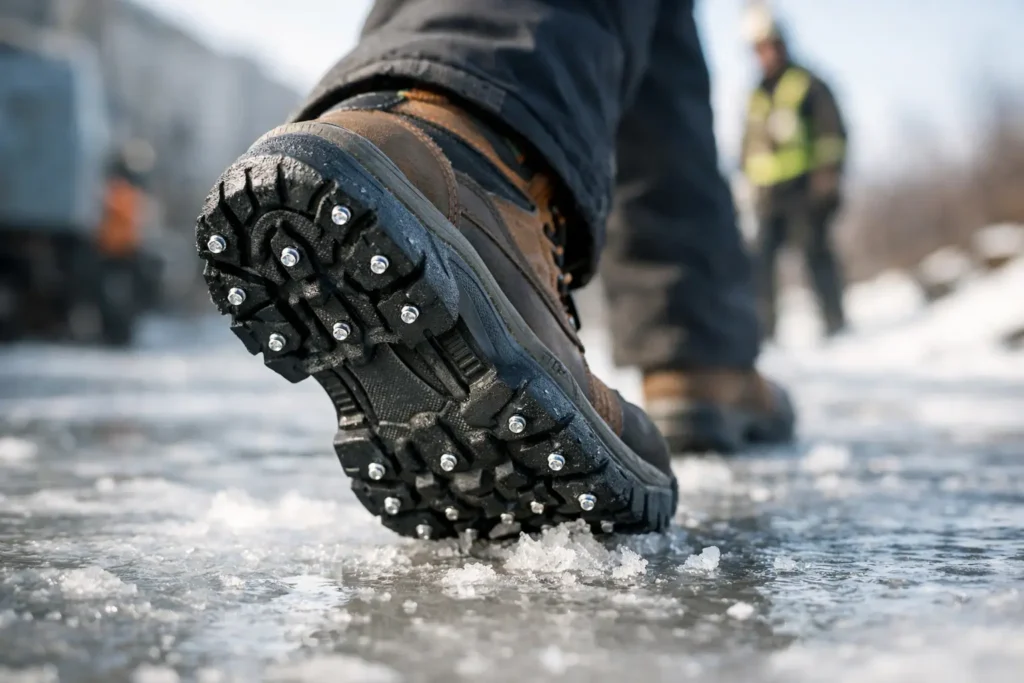
A slick loading dock, frozen ladder rung, muddy slope, or hard-packed snow route can turn a normal shift into an injury risk in one bad step. The best boot traction for workers is not simply the sharpest option available. It is the traction that grips the surface underfoot while letting you walk, climb, carry, and work with a natural, confident stride.
For people who work outdoors, traction is safety equipment. It affects how hard you have to concentrate on each step, how quickly fatigue builds, and whether you can move decisively when the job will not wait for better weather. The right setup should stay out of your way until the ground gets ugly – then it should bite.
Why Work Boot Traction Fails When Conditions Change
Most work boots have lugged outsoles designed for general traction. Those lugs can shed loose dirt and grab uneven ground reasonably well, but rubber alone has limits. On glare ice, compacted snow, slick wet leaves, oily gravel, or frozen mud, even an aggressive tread can skate across the surface.
The problem gets worse because job sites rarely offer one predictable terrain. A utility worker may move from a plowed road to an icy yard and then onto metal steps. A landscaper can start on frozen grass, cross loose gravel, and finish in mud by afternoon. Warehouse and delivery crews may go between smooth concrete, slush, ramps, and truck beds all day.
That is why the best traction system is built for real movement across mixed conditions, not one perfect patch of ice. It needs to add grip without creating a clumsy, unstable feel on the surfaces you cross between hazards.
Best Boot Traction for Workers: What Actually Matters
A traction choice should match the job, the boot, and the ground. Price and appearance matter far less than how the system performs after hours of walking, lifting, bending, and climbing.
Direct contact with the ground
Effective traction must reach beyond the rubber sole. On ice, the goal is penetration: a hard point needs to break through the thin meltwater layer and engage the frozen surface below. On mud, gravel, and roots, that same point can create extra purchase where a flat or packed-out outsole slides.
Deep rubber lugs are still useful, especially in loose soil and snow. But when surfaces are hard, glazed, or inconsistent, metal traction points offer a level of bite that rubber cannot reliably duplicate.
A secure connection to the boot
Many workers start with pull-on cleats because they are easy to buy and remove. They can help in a limited situation, but straps, chains, and harnesses introduce another failure point. They can shift under the sole, pack with snow, catch on debris, loosen in cold weather, or change how the boot flexes.
A direct-to-sole system avoids that floating, over-the-boot feeling. Screw-in traction spikes become part of the footwear rather than another layer wrapped around it. That means the traction stays where it belongs when you pivot, step off a curb, climb a grade, or carry a heavy load.
Natural gait and low fatigue
Workers cannot afford gear that makes every step awkward. Bulky traction devices can raise the foot off the ground, create uneven pressure, and make walking on hard surfaces feel stiff or unstable. Over a long shift, that altered gait can add fatigue to calves, knees, hips, and feet.
Low-profile spikes preserve more of the boot’s original feel. You still have the support, cushioning, and fit you chose in your work boot, with added points of contact for slick terrain. The goal is not to walk like you are wearing crampons. It is to walk normally with more confidence.
Durability under real work
Traction gear sees abuse. It meets asphalt, concrete edges, rocks, grates, frozen soil, and truck steps. Lightweight does not mean disposable. Look for hardened components and a mounting method designed to stay secure through repeated use.
Durability also means practical serviceability. If a traction point wears down after long use, the ability to replace it is more useful than tossing an entire device. Workers need equipment that earns its place in the truck, not seasonal gear that fails when conditions get rough.
Match Your Traction to the Job Site
There is no single setup that is perfect for every job, because terrain changes how traction behaves. A worker spending most of the day on smooth indoor floors has different needs than someone walking a frozen trail, working a roofline, or hauling equipment across a muddy property.
For ice-heavy work, prioritize sharp, strategically placed metal points that contact the ground at the heel and forefoot. Heel traction matters when walking downhill or stepping backward. Forefoot traction matters when pushing off, climbing, or carrying weight uphill.
For mud, gravel, and unstable ground, combine a good lug sole with traction points that provide extra bite. The boot’s tread still needs room to clear debris. No traction accessory can fully compensate for a sole packed solid with clay.
For mixed routes that include pavement, concrete, snow, and dirt, low-profile screw-in spikes are often the strongest choice. They add grip where it counts without the dangling chains or oversized profile that can make transitions uncomfortable. This is where an integrated system such as ICESPIKE makes practical sense: it is designed to stay close to the sole, support a natural gait, and provide traction beyond a single winter use case.
For ladders, rungs, roofs, and metal surfaces, follow your employer’s safety requirements and assess compatibility before adding any traction product. Some spike configurations can be unsuitable for certain finished floors, delicate surfaces, or climbing equipment. Better grip is valuable only when it works with the task and site rules.
Where to Place Traction Spikes on Work Boots
Placement matters as much as the spike itself. A few well-positioned points can provide better usable grip than a crowded sole covered randomly with hardware.
Start with the high-contact zones: the heel strike area and the forefoot where you push off. These are the parts of the boot that need help when you walk downhill, climb, turn, or brace under a load. Avoid thin sections of the sole, air pockets, and areas where the boot flexes heavily unless the product instructions specifically allow installation there.
Think about your movement pattern. A delivery driver who repeatedly steps down from a truck may benefit from strong heel coverage. A trail crew member climbing uneven grades needs dependable forefoot engagement. A worker who spends hours on side slopes needs balanced traction across both sides of the sole, not all of it centered in one line.
Before installation, inspect the outsole thickness and construction. A spike must seat securely without reaching the insole or damaging structural components. Use the manufacturer’s placement guidance, and check the spikes periodically, especially during the first several shifts. A quick inspection before heading out is easier than discovering a loose component halfway across an icy site.
Avoid These Common Traction Mistakes
The first mistake is waiting until after a fall to upgrade your boots. If your job routinely puts you on ice, snow, mud, wet grass, or uneven ground, traction should be part of your preparation, not an emergency purchase.
The second is assuming all slip resistance is the same. A boot labeled slip-resistant may perform well on certain wet indoor surfaces but still struggle on glare ice. Read the conditions the sole is designed for and choose additional traction accordingly.
The third is wearing aggressive traction everywhere without considering the surface. Metal points can feel different on polished concrete, finished flooring, and hard interior surfaces. If you move frequently between protected indoor areas and hazardous outdoor ground, choose a removable or adjustable solution and use it with intention.
Finally, do not ignore the rest of the boot. Worn-out tread, poor fit, inadequate ankle support, and wet socks can undermine even excellent traction. Secure footing starts with a boot that fits correctly, supports the work, and remains in good condition.
Traction Is Part of Working With Confidence
Good work does not stop because the ground is slick. But moving faster is never worth gambling with a fall, a twisted knee, or a dropped load. The right traction lets you focus on the task instead of calculating every step.
Choose a system that bites into the hazards you actually face, stays secure through a full shift, and does not punish your gait on the way there. When the weather turns or the terrain gets unstable, your boots should help you keep moving with purpose.