
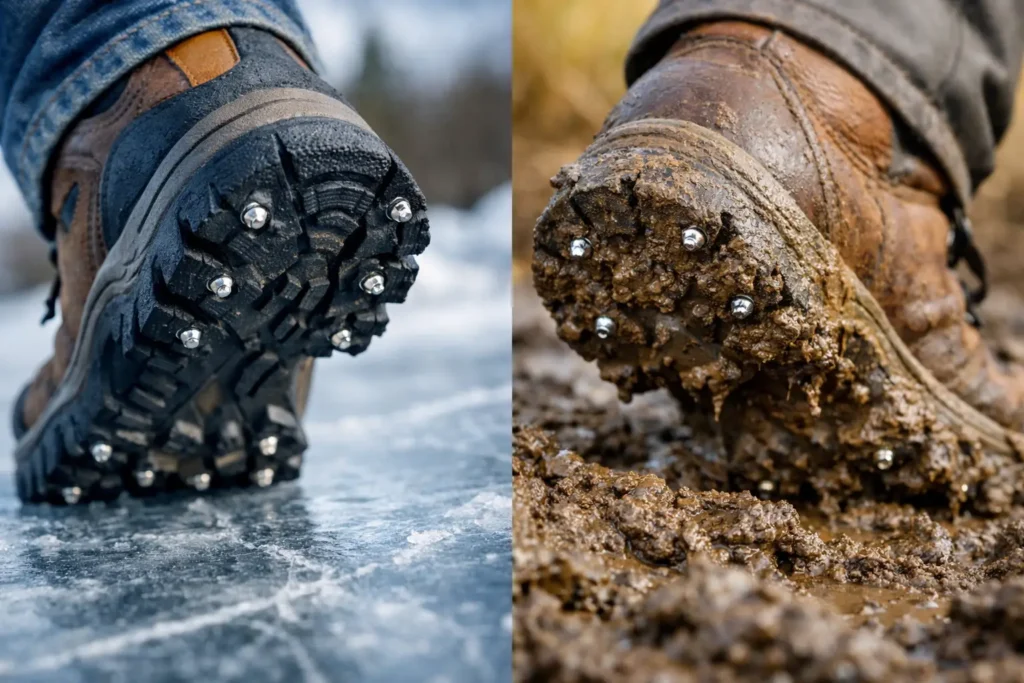
A polished sidewalk can turn into black ice before you reach the truck. A frozen trail can become mud by noon. That is why choosing between boot traction options is not just about buying more grip. It is about choosing traction that matches your terrain, your footwear, and the way you actually move.
The wrong setup can feel heavy, shift underfoot, pack with snow, or force you into an awkward stride. The right one gives you a planted, confident step without turning every walk, work shift, or winter run into a gear-management problem.
How to Choose Boot Traction Options
Start with the surface, not the forecast. Snow alone is rarely the issue. Packed snow, glare ice, wet leaves, loose gravel, slick roots, frozen mud, and slushy pavement all demand grip in different ways. A traction solution that feels aggressive on a frozen lake may be uncomfortable or unnecessary on a grocery store floor. One that works well on hard-packed snow may not bite reliably into smooth ice.
Also consider how often you transition between surfaces. If you walk from a driveway to a jobsite, from a trailhead to rocky ground, or from snowy sidewalks into buildings, your traction needs are different from someone spending all day on a frozen river or steep winter trail. Convenience matters because gear that is annoying to wear, carry, or reinstall often stays in the closet when conditions turn dangerous.
Your boot matters too. A deep lug sole gives useful traction in dirt and loose snow, but rubber lugs alone can slide across hard ice. A stiff work boot can support more aggressive hardware than a lightweight hiking shoe. Before adding any traction, inspect the outsole. Look for solid rubber areas, adequate sole thickness, and enough space to place traction points where they will contact the ground without interfering with your natural stride.
Built-In Lug Soles: Good for Loose Ground
Most work boots, hiking boots, and winter boots begin with a lugged outsole. Deep, widely spaced lugs shed mud and bite into loose snow, dirt, and soft terrain. For everyday winter conditions where the ground is mostly snowy or uneven rather than icy, a quality lug sole can be enough.
The limit appears when the surface hardens. Rubber lugs need something to deform around or push into. On smooth, dense ice, they have very little to grab. Wet ice is even worse because a thin layer of water can make a boot sole skate. If hard ice is a regular part of your route, lugs are a foundation, not a complete traction strategy.
Strap-On Cleats: Easy to Share, Easy to Forget
Pull-on traction cleats use a rubber or elastomer harness to hold coils, chains, plates, or small spikes beneath the boot. Their biggest advantage is flexibility. They can move from one pair of footwear to another, and they are simple to remove before entering a building.
For occasional use on icy sidewalks, they can be a practical choice. They also make sense for family members who need a temporary solution for a short trip or a rare winter storm. But the trade-off is familiar to many outdoor workers and active winter users: strap-on systems can shift, stretch, loosen, collect snow, and change the way a boot flexes.
The harness sits around the outside of the footwear, adding bulk where many people do not want it. On narrow boots, heavily worn boots, or shoes with unusual shapes, fit can become inconsistent. Chains and coils can also feel unstable on mixed surfaces, especially when you move from ice to hard pavement, rock, or indoor flooring. They work best when you can put them on for a specific icy section and take them off afterward.
Chain and Spike Systems: Strong Bite for Dedicated Ice
Heavier chain-based systems with metal spikes are designed for more serious winter travel. They are common among ice anglers, winter hikers, and people moving through consistently frozen terrain. The pointed metal elements can provide strong purchase on hard ice, while chains allow the system to flex with the sole.
That strength comes with a cost. More metal usually means more weight, more bulk, and a more noticeable change in gait. A heavy underfoot setup can be tiring during long walks, and it can feel awkward on pavement or mixed trails. Snow can also build around chains and connection points. These systems are often excellent for their intended job, but they are not always the best all-day answer for a worker, runner, or hiker covering changing terrain.
Screw-In Traction: Integrated Grip Without the Harness
Screw-in spikes and cleats attach directly to the sole, putting traction where it counts without wrapping the upper part of the boot in a harness. For people who regularly face ice, packed snow, mud, gravel, slick roots, or unstable ground, this approach creates a more integrated feel than an over-shoe device.
The key advantage is placement. Traction points can be installed in the heel and forefoot areas that naturally contact the ground during a stride. That supports a more normal walking or running motion while adding bite exactly where slips often begin. Because there are no chains draped below the sole and no rubber bands around the boot, there is less extra material to shift, snag, or interfere with movement.
This option is especially useful for people who do not have the luxury of stopping to gear up. Outdoor workers stepping in and out of vehicles, trail runners covering changing winter routes, dog walkers, hunters, and older adults navigating icy driveways need reliable footing that is already there. ICESPIKE screw-in traction is built for that kind of direct-to-sole performance, with a lightweight profile that helps boots keep their natural feel.
Screw-in traction is not a one-size-fits-all solution. Installation requires a compatible outsole and careful placement. Very thin soles, badly worn soles, or footwear with air pockets may not be suitable. You also need to think honestly about where the boot will be worn. Metal traction can damage delicate indoor surfaces and may feel slick on smooth tile or polished concrete. Removable spikes offer an advantage when you need to switch quickly between aggressive outdoor grip and clean indoor floors.
Studded Winter Boots: Convenient but Limited
Some winter boots come with built-in studs, carbide elements, or specialized rubber compounds. This can be convenient because the traction is part of the boot from day one. There is nothing to install, stretch over the sole, or store in a pocket.
The downside is commitment. If the boot wears out, the traction goes with it. If the stud pattern does not fit your stride or terrain, you cannot easily adjust it. Dedicated studded boots may also be overkill for someone who wants dependable grip across several pairs of footwear, such as work boots during the week and hiking boots on weekends.
These boots are a strong option for people who want one dedicated winter pair and spend most of their time in cold, icy conditions. They are less flexible for year-round users or anyone who needs traction across multiple activities.
Match the Traction to the Job
A runner needs a setup that stays light, does not slap against the ground, and allows the shoe to flex naturally. A hiker needs confidence on ice-covered rock, steep packed snow, and muddy descents. A construction worker or utility worker needs traction that holds through long shifts without becoming another piece of equipment to adjust. An older adult may prioritize a secure, predictable step over aggressive mountain-grade bite.
No single design wins every condition. Strap-on cleats are convenient for occasional ice. Heavy chains and spikes excel when hard ice is the main event. Lug soles handle loose terrain well. Direct-to-sole spikes make the most sense when dependable, low-profile traction needs to stay with the boot through changing conditions.
Before committing, ask three practical questions: How often do I encounter ice or unstable ground? Will I move between outdoor and indoor surfaces? Do I need traction for one outing, or do I need it ready every time I lace up? Your answers will point toward the setup that protects both your footing and your freedom of movement.
A good traction choice should make winter and unstable terrain feel less like an obstacle course. When every step feels planted, you can focus on the trail, the job, the catch, or getting home safely instead of wondering when the ground will slide out from under you.