
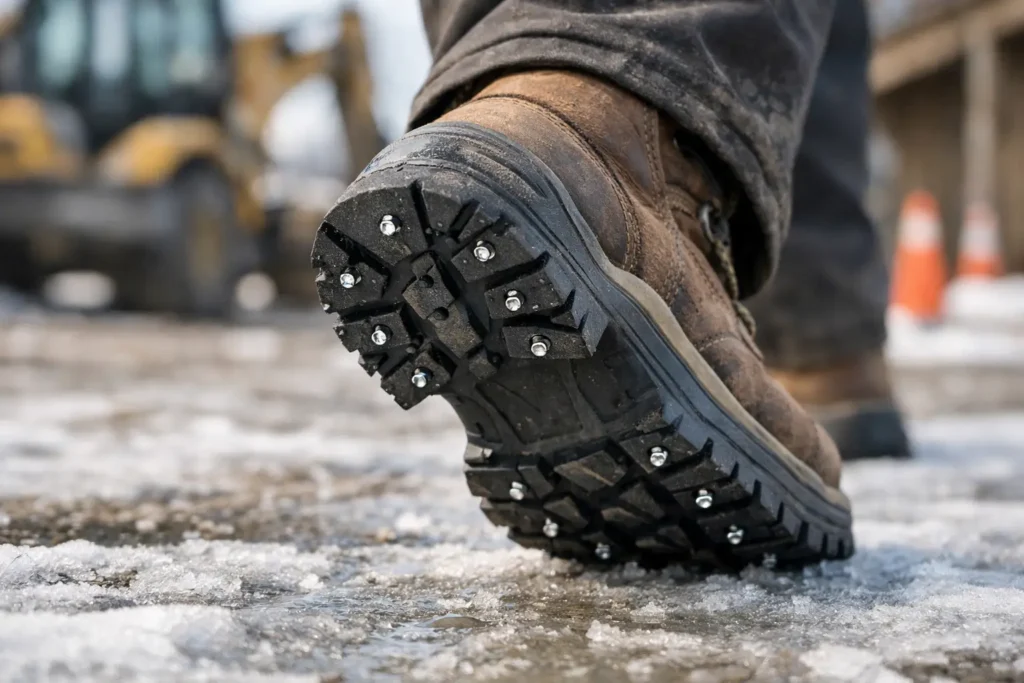
A frozen loading dock at 6 a.m. does not care how tough your work boots look. Neither does a muddy utility right-of-way, an icy stairwell, or a gravel slope glazed with sleet. Lightweight traction for work boots is about giving every step more bite without turning your boots into heavy, awkward equipment that wears you down before the shift is over.
For outdoor workers, traction is not a luxury add-on. It is part of the job. The right system should help you move with confidence across changing ground, preserve the natural feel of your boots, and stay out of the way when conditions are dry, hard-packed, or mixed.
Why Heavy Cleats Can Make Work Harder
Traditional strap-on traction devices solve one problem while creating several others. Their chains, coils, and rubber harnesses can add bulk underfoot, collect mud and snow, and change the way your boot rolls from heel to toe. That matters when you are walking long distances, climbing in and out of vehicles, carrying materials, or working on your feet for ten hours.
A heavy setup can also feel unstable on uneven ground. The device may shift against the sole, the harness can loosen, and packed snow can reduce the very grip you put it on for. Workers often leave strap-on cleats in the truck because they are inconvenient to install, uncomfortable to wear, or simply too clumsy for a day that moves between pavement, dirt, ice, and indoor surfaces.
The result is familiar: people take chances on slick ground because the alternative feels like walking in oversized gear. That is not a good trade.
What Lightweight Traction for Work Boots Should Deliver
Lightweight does not mean weak. It means the traction system adds purposeful grip without adding unnecessary weight, height, or movement under the sole. A good setup should feel integrated with the boot rather than strapped over it.
For working conditions, that means traction needs to do more than handle a smooth patch of ice. It should bite into frozen ground, crusted snow, loose gravel, wet leaves, mud, slick roots, and the unpredictable mix of surfaces found around job sites and outdoor properties.
The best lightweight systems also keep the profile low. When traction is close to the sole, your foot stays closer to its normal position. That supports a more natural gait and can reduce the fatigue that comes from constantly compensating for a bulky device under your boots.
There is no single traction pattern that is perfect for every job. A worker who spends most of the day on pure ice may want more aggressive points than someone moving between icy ground and cleared concrete. But for many crews, the winning combination is sharp, durable grip in a compact, direct-to-sole design.
Direct-to-Sole Spikes Change the Equation
Screw-in traction spikes attach directly to the outsole of compatible work boots. Instead of wrapping the entire boot in rubber and metal, the spikes sit where traction is needed most. The boot remains the boot you selected for support, comfort, waterproofing, and job protection. It simply gains more authority on unstable terrain.
That direct connection is the key difference. There is no floppy harness to pull into place and no chain webbing hanging beneath the boot. The traction becomes part of the outsole, creating a more secure, natural-feeling platform for walking and working.
ICESPIKE uses this approach to give workers strong grip in a lightweight package. Properly installed spikes can be placed to match the areas of the sole that contact the ground most often, helping deliver dependable bite without covering every inch of tread in hardware.
This matters on mixed terrain. You may start the morning crossing frozen dirt, spend mid-shift on a muddy slope, and finish on snow-packed ground near a truck. A low-profile spike system is built for that kind of real-world movement, not just a short walk across an icy driveway.
The Work-Boot Fit Matters as Much as the Spike
Traction works best when it starts with the right boot. A work boot with a firm, substantial outsole gives screw-in spikes a better foundation than a thin, highly flexible sole. Deep lugs can also help, especially in mud and loose snow, while the added spike points address the hard, slick surfaces that rubber tread alone cannot always handle.
Before adding traction, inspect the sole. Avoid severely worn-out boots, cracked outsoles, or areas where the tread is too thin to hold a spike securely. The goal is a strong connection that stands up to miles of movement, repeated flexing, and the hard impact of a busy workday.
Placement deserves attention, too. The heel and forefoot are natural high-contact zones, but your stride, job demands, and boot tread design all affect where traction is most useful. Install spikes in solid rubber sections rather than thin edges or hollow lugs. Keep them clear of areas that could interfere with the boot’s intended flex.
If your work includes ladders, smooth interior floors, delicate finished surfaces, or specialized safety requirements, use judgment. Aggressive traction may not suit every surface. Removable screw-in systems offer a practical advantage here: you can adapt your footwear when the conditions or workplace rules change.
More Grip Should Not Mean More Fatigue
Foot fatigue is a safety issue. Tired feet affect balance, concentration, and the way you move through a job site. When your traction gear is heavy or changes the height and shape of your footing, every step asks your legs to do extra work.
Low-profile traction helps minimize that penalty. Your boot can still flex more naturally, your heel-to-toe transition remains closer to normal, and the weight stays focused at the sole instead of hanging around the sides of the boot. Over a long shift, that difference can be significant.
This is especially valuable for workers who cover distance: delivery drivers, utility crews, property maintenance teams, construction workers, farm workers, arborists, surveyors, and anyone who cannot choose the ground under their feet. They need traction that is ready when conditions turn ugly, not gear that becomes another obstacle.
Built for More Than Ice
The phrase “ice cleat” can make traction sound like seasonal equipment, but unstable ground shows up all year. Spring brings saturated soil and slick grass. Summer work can mean loose gravel, steep trails, wet rocks, and dusty slopes. Fall adds rain-soaked leaves, roots, and mud. Winter stacks ice and packed snow on top of everything else.
A lightweight, direct-to-sole traction approach makes sense for workers who face those conditions regularly. It is not about making every surface feel identical. Nothing can do that. It is about increasing the margin between stable footing and a sudden slide.
That margin matters when you are carrying a tool bag, guiding equipment, walking near traffic, or working alone in a remote area. Better traction cannot replace awareness, proper footwear, or smart site practices. It can give you more control when the surface stops cooperating.
When to Choose Lightweight Spikes Over Strap-On Cleats
Strap-on cleats still have a place. They can be useful for occasional exposure to ice, for footwear that cannot accept installed spikes, or for users who need to move traction from one pair of shoes to another. If you only encounter slippery ground a few times each winter, a removable overshoe device may be enough.
But daily outdoor work is different. Frequent users need gear that is fast, dependable, and comfortable enough to leave on for the job. That is where integrated, lightweight spikes stand apart. They remove the recurring hassle of putting on a harness, checking its fit, clearing buildup, and tolerating a changed gait all day.
The strongest traction choice is the one you will actually wear. If a system feels bulky, slips around, or takes too long to manage, it will eventually stay in the truck. A direct-to-sole option keeps grip close, tough, and ready for the next bad patch of ground.
Make Every Step Count
Work boots are built to protect your feet. Lightweight traction gives them a better chance to protect the rest of you when ice, mud, gravel, and uneven terrain challenge every step. Choose a system that respects the boot’s natural movement, matches the surfaces you work on, and delivers serious bite without dragging down your day.
The ground will not always be predictable. Your footing can be.