
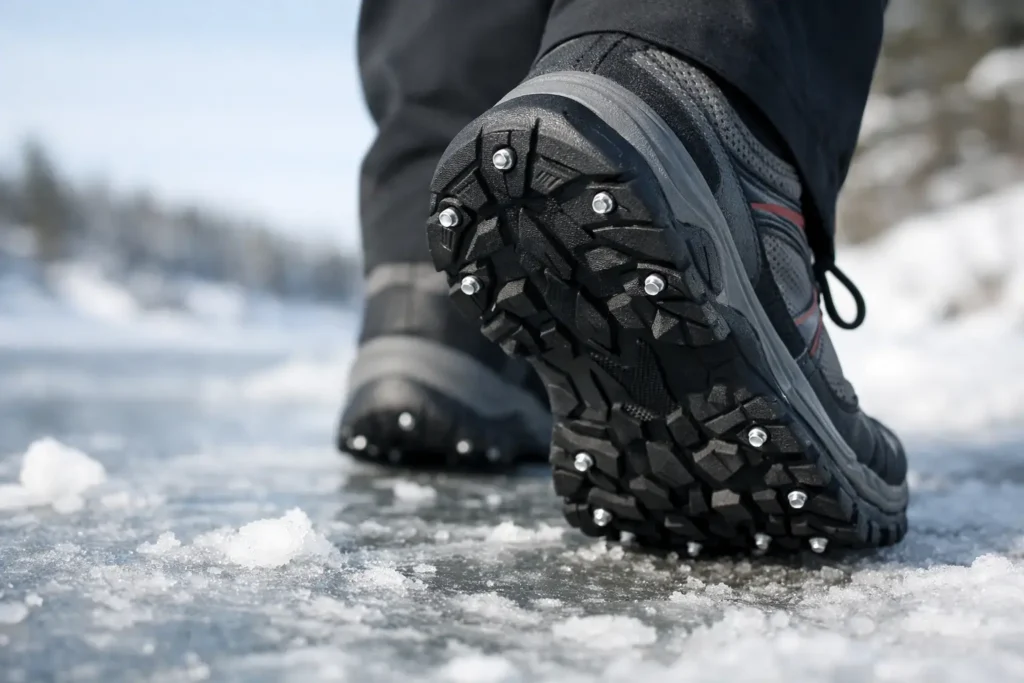
A glazed parking lot, a frozen trailhead, or a slick set of front steps can turn an ordinary walk into a hard fall in one careless step. That is why a useful winter traction spikes review cannot stop at whether a product bites into ice. It has to ask a tougher question: will that traction still feel secure, comfortable, and dependable after miles of mixed ground?
The answer depends on how the spikes connect to your footwear. Some systems wrap around the shoe with rubber harnesses, chains, coils, or plates. Others install directly into the outsole. Both can add grip, but they do not move, wear, or feel the same underfoot. For runners, hikers, outdoor workers, and anyone walking through a real winter instead of a perfectly icy sidewalk, that difference matters.
Winter Traction Spikes Review: What Actually Matters
Traction starts with contact. A spike needs to reach through thin ice, packed snow, loose soil, or surface grime and create a stable point of purchase. But aggressive bite alone is not the whole story. The best setup also stays where it belongs, supports a natural stride, and does not leave your feet exhausted after an hour outside.
Traditional over-shoe cleats can perform well on sustained ice. Their chains and metal points create a broad traction surface, which can be useful for slow walking on frozen paths. The trade-off is bulk. A harness can shift under load, collect snow and debris, or make a shoe feel wider and less predictable. On bare pavement, uneven gravel, stairs, or transitions between surfaces, that extra hardware can alter how your foot lands.
Direct-to-sole spikes take a different approach. Rather than placing a separate traction device around the shoe, they become part of the outsole. A properly installed screw-in system sits close to the sole, so the shoe retains more of its original flex and fit. The goal is not to make every step feel like a mountaineering boot. It is to add a firm, low-profile edge when terrain gets slick.
That is a major advantage for people who move fast or work long days. Trail runners do not want a floppy harness interrupting cadence. Hikers do not want to remove and reinstall gear every time a trail shifts from snow to rock. Workers need traction that stays put while carrying equipment, climbing in and out of vehicles, and crossing unpredictable ground.
Grip Is Only Useful If You Can Trust It
A traction device earns its place when it is predictable. If it slides on the shoe, rotates at the heel, or loosens after repeated use, it creates another problem instead of solving one. Rubber strap systems are especially dependent on fit. One model may work well over a bulky insulated boot but feel loose over a low-profile running shoe. Cold temperatures can also make rubber less forgiving, and repeated stretching eventually takes a toll.
Installed spikes avoid that fit issue because they are anchored in the outsole. There is no external harness to pull over the toe, no chain to catch on brush, and no need to wonder whether the device is centered before heading out. For everyday winter footwear, that simpler setup can be the difference between using traction consistently and leaving it in the trunk.
Placement matters, too. Traction should support the parts of the foot that take the most force during walking or running. Heel contact needs stability, while the forefoot needs purchase during push-off. A sensible spike pattern gives you grip at both ends of the stride without turning the entire sole into a rigid, noisy platform.
This is where screw-in traction has an edge over improvised screw shoes. A handful of random hardware-store screws may seem like a quick fix, but screw heads are not designed around footwear traction, and installation depth can be inconsistent. Purpose-built spikes are engineered for this job. They offer a more controlled fit, better durability, and a cleaner way to upgrade shoes and boots you already trust.
The Real Test Is Mixed Terrain
Pure ice is easy to picture. Real winter is rarely that simple.
You may leave the house on dry concrete, cross a patch of black ice, walk through slushy snow, climb a muddy trail, and finish on gravel. A good winter traction system handles those transitions without forcing you to stop, remove gear, and change your gait every few minutes.
Over-shoe cleats can feel awkward on hard, bare surfaces because their chains, plates, or prominent points sit between the shoe and the ground. They may be the right choice for a dedicated ice walk, especially when the route is consistently frozen. But they are less appealing when the day includes errands, trail approaches, packed snow, slick roots, and pavement.
Low-profile installed spikes are built for that broader reality. They provide an added layer of bite on ice and snow while staying close enough to the sole for more natural movement on mixed ground. That makes them especially practical for winter runners, dog walkers, delivery crews, maintenance workers, anglers moving across wet banks, and hikers who cannot predict what is around the next bend.
No traction product makes polished indoor floors, smooth tile, or metal grates automatically safe. Spikes can also be noisy and may mark sensitive surfaces. Good judgment still matters. If you are entering a building or crossing a surface where metal points are inappropriate, slow down or remove footwear if needed.
Comfort and Gait Separate Good Gear From Gear You Avoid
The most powerful traction system is useless if it stays in a closet. Comfort is not a luxury feature. It determines whether you will wear the gear before conditions get dangerous.
Bulky traction devices can change the height and shape of the outsole. That may create pressure points, affect balance, or make a normal walking stride feel mechanical. For seniors and anyone returning from an injury, a sudden change in footing can be unsettling. For runners, even a slight disruption in cadence can become irritating over distance.
A direct-to-sole system keeps the shoe closer to its intended feel. You still notice the added contact on hard surfaces, but you are not carrying a separate layer of rubber, chains, and straps around the boot. The lighter, integrated feel reduces the temptation to alter your stride, which can help limit fatigue over longer outings.
That does not mean every shoe is a perfect candidate. Thin, worn-out soles do not provide the same secure installation base as a sturdy running shoe, hiking boot, or work boot. Before installing spikes, inspect the tread and outsole thickness. Choose footwear with enough healthy material to hold the spike securely, and follow the installation guidance for the specific product.
Durability, Removability, and Cost Over a Season
Winter traction gear gets abused. It sees salt, frozen dirt, road grit, mud, and constant impact. A review should look beyond the first walk and consider whether a system will keep working through the season.
Strap-on systems are easy to transfer between shoes, which is their main strength. If you only need traction a few times each year and use one heavy boot, that convenience may outweigh the bulk. The downside is that straps, chains, and attachment points are all wear items. A broken harness can sideline the entire device.
Screw-in spikes require a few minutes of installation, but they give the shoe a more permanent-ready traction upgrade. They can also be removed when conditions change or when you want to move to a different pair. That flexibility is valuable for people who rotate footwear by activity or season.
ICESPIKE’s patented screw-in system is particularly well suited to users who want serious traction without turning everyday footwear into a clumsy, winter-only setup. The value is not just the spike itself. It is the ability to keep wearing the shoes or boots that already fit your feet, your work, and your movement.
Who Should Choose Which Winter Traction System?
If your activity is slow walking on uninterrupted ice, a traditional strap-on cleat can be a reasonable choice. It is simple, widely familiar, and easy to share between compatible boots. Just expect more bulk and pay attention to fit.
If your day involves frequent terrain changes, installed spikes are generally the stronger option. They make sense for runners who need a clean stride, hikers covering snow and rock, workers who cannot pause to adjust gear, and practical walkers who want confidence on icy driveways without wrestling with a harness.
For older adults, the best choice is the one that will actually be worn. A lightweight, secure solution on a familiar pair of shoes can feel less intimidating than a large over-shoe device. As with any safety gear, practice on a controlled outdoor surface before trusting it on steep ice or a long walk.
A winter traction purchase should not be judged by how dramatic it looks in the box. Judge it by the moments when footing suddenly disappears: the shaded sidewalk, the frozen loading area, the downhill trail, the wet rocks at the edge of the water. Choose the system that lets you meet those moments with a steady step instead of a second thought.