
Our Website if down for construction for awhile. Not a good time of year but needed to be done. If you need product or help in the mean time please call us at 877-677-3567 Thanks for you understanding.
Our Website if down for construction for awhile. Not a good time of year but needed to be done. If you need product or help in the mean time please call us at 877-677-3567 Thanks for you understanding.
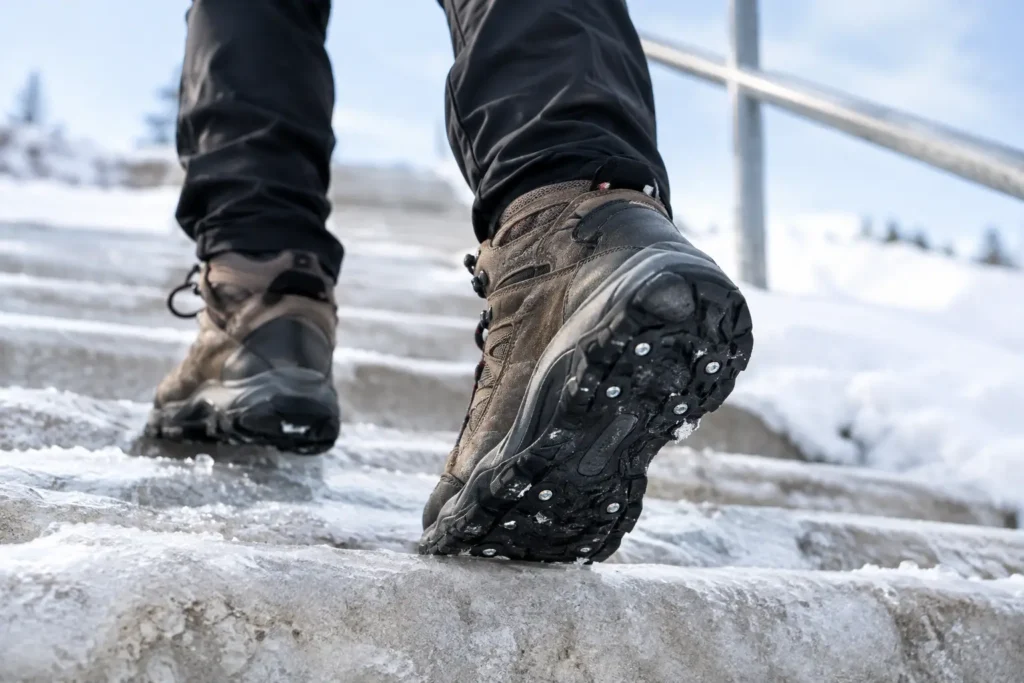
A glazed front staircase can turn a normal trip to the mailbox into the most dangerous 20 feet of your day. The problem is not just cold weather. It is the combination of hard, angled surfaces, thin ice you may not see, and the split-second weight transfer that happens as you step down. Effective shoe traction for icy stairs gives you a secure point of contact when rubber tread alone starts sliding.
For runners heading out before sunrise, workers making repeated trips in and out of a building, and anyone carrying groceries or walking a dog, the right traction changes the equation. You move with more confidence because your footwear is built to grip the surface beneath it, not just hope the weather improves.
Why icy stairs demand more from your footwear
Ice is difficult anywhere, but stairs magnify every weakness in your footwear. On flat ground, you may be able to shuffle, widen your stance, or recover from a minor slide. On stairs, each step has an edge, a slope, and a fall path. A slip can send your foot forward while the rest of your body keeps moving down.
Standard boot lugs help in packed snow, soft ground, and loose gravel. They are far less dependable on smooth, refrozen ice. The rubber can become stiff in low temperatures, and even aggressive tread patterns have limited ability to penetrate a hard, slick surface.
That is where small, durable metal traction points earn their place. They create concentrated pressure that can bite into ice instead of skimming over it. The goal is not to make you invincible. It is to give you more reliable purchase, so your footing feels deliberate rather than tentative.
What shoe traction for icy stairs needs to do
Not every traction solution works well on stairs. The best choice depends on the shoes you wear, the type of ice you encounter, and whether you move between outdoor and indoor surfaces throughout the day. Still, dependable stair traction should deliver four things:
- A firm bite into hard ice, including thin black ice and polished refrozen patches.
- A stable, low-profile fit that does not shift under your foot during descent.
- Enough coverage to support natural heel-to-toe movement.
- Durable construction that can handle repeated use on rough winter surfaces.
The first point matters most. Ice traction works by focusing your body weight through hard contact points. Broad rubber surfaces spread that force out. Purpose-built spikes concentrate it, helping the footwear engage the ice.
Stability matters just as much. A traction device that slides around your sole can be distracting at best and dangerous at worst. When your foot lands on a stair edge, you need the traction to stay where it belongs. You should not have to stop halfway down the steps to readjust a loose harness.
The limits of strap-on cleats on stairs
Traditional over-shoe traction devices can offer useful grip, especially for occasional walks on snow-covered paths. But icy stairs expose their trade-offs quickly. Many use elastic harnesses, chains, coils, or plates under the sole. Those parts can feel bulky, alter how your shoe flexes, and create an uneven sensation when you step.
A strap-on device may also shift if it is not tightly fitted to the exact shoe you are wearing. That can be frustrating when you are switching between work boots, running shoes, and casual winter footwear. It also adds a task at the worst time: when you are already standing at a slippery doorway trying to get outside.
There is another practical issue. Most traction systems that hang beneath the sole are not designed for normal indoor flooring. You need to remove them before walking across tile, hardwood, or finished concrete. For someone going in and out all day, that repeated on-off routine becomes one more reason traction gets left behind.
This does not mean strap-on cleats never have a place. They can make sense for emergency use, infrequent winter travel, or footwear that cannot accept installed traction. But for people who face icy steps regularly, an integrated, direct-to-sole solution is often the more secure and natural-feeling choice.
Direct-to-sole spikes keep the stride more natural
Installable traction spikes are designed to sit directly in the outsole of shoes or boots. Instead of wrapping around the upper, they become part of the sole. That makes a major difference in how footwear feels on stairs and across mixed terrain.
A low-profile screw-in system adds traction where it counts without turning your shoes into clunky winter equipment. The shoe can still flex. Your heel can still land naturally. Your foot is not fighting a strap, chain, or oversized plate beneath it.
ICESPIKE uses a patented screw-in design that lets users add durable, removable traction to compatible footwear. When installed in a thoughtfully planned pattern, the spikes give everyday shoes, work boots, hiking boots, and trail shoes a tougher grip on ice, snow, mud, gravel, and slick roots. That matters because winter rarely gives you one surface for the whole day.
For stairs, placement should support both the heel strike and the forefoot push-off. A balanced pattern helps when walking down, where heel control is critical, and when walking up, where the forefoot needs to engage. Follow the manufacturer’s installation guidance and make sure the outsole has enough material to safely hold the spike.
Match your traction to the shoes and job
The best footwear for icy stairs is the pair you will actually wear when conditions turn bad. That is why compatibility matters. A homeowner may want traction in a favorite pair of winter walking shoes. A delivery driver may need it in durable work boots. A trail runner may want a light setup that still feels fast and responsive.
Choose a shoe or boot with a substantial rubber outsole. Deep lugs are helpful, but the key requirement for installed spikes is enough sole thickness in the intended locations. Avoid placing hardware in thin, hollow, badly worn, or heavily segmented sections of the sole. If the outsole is nearing the end of its life, replace the footwear before investing time in traction.
Consider where you walk after leaving the stairs. If your route includes a driveway, sidewalks, frozen parking lots, and a trail, you need traction that handles transitions without constantly changing your gait. If you are primarily stepping from a warm house onto a few icy porch steps, a lighter, more targeted setup may be enough.
There is a trade-off: more spikes can provide more points of contact on ice, but you do not need to overload a sole to get meaningful benefit. Strategic placement, quality materials, and secure installation beat a random handful of hardware every time.
Use better movement habits with better grip
Traction is a serious safety upgrade, not permission to rush down frozen steps. Even the strongest spikes can lose purchase on uneven ice, loose debris, wet painted wood, or stair treads covered in slush. Smart movement gives your traction the best chance to work.
On icy stairs, slow down before the first step. Keep your body weight centered over your feet rather than leaning backward. Use the handrail whenever one is available, especially when carrying bags or walking in the dark. Take each step flat and controlled instead of landing only on the heel or toe.
Pay attention to the transition areas too. The top and bottom steps often collect the most meltwater, which refreezes into a thin layer that is easy to miss. Porch shadows, north-facing steps, and areas below a dripping roofline can stay icy long after the rest of the walkway looks clear.
Good traction works alongside basic maintenance. Shovel snow before it gets compacted. Use an appropriate ice melt for the surface and conditions. Repair loose handrails and worn tread covers. The safer the stairway itself becomes, the more effectively your footwear can do its job.
Know when to remove or adjust traction
Metal traction points are built for outdoor grip, not polished indoor floors. Walking on hardwood, tile, stone, or other finished surfaces can damage the floor, reduce comfort, and create a new slipping risk. Plan your footwear around your route. Keep a clean pair of indoor shoes nearby if you regularly move between an icy exterior and finished interior flooring.
Inspect installed traction periodically, particularly after long runs, hard work shifts, or travel across gravel and pavement. Check that each spike remains secure and that the surrounding sole has not cracked or worn down. Replace worn footwear before the sole can no longer hold traction safely.
The right setup should feel dependable, not complicated. If your traction changes the way your feet move, catches awkwardly, or requires constant adjustment, it is not serving the job.
Winter stairs do not need to dictate your plans. Build grip into the footwear you trust, use the handrail, and take the steps one controlled stride at a time. When ice shows up overnight, secure footing is not a luxury. It is how you keep moving.