
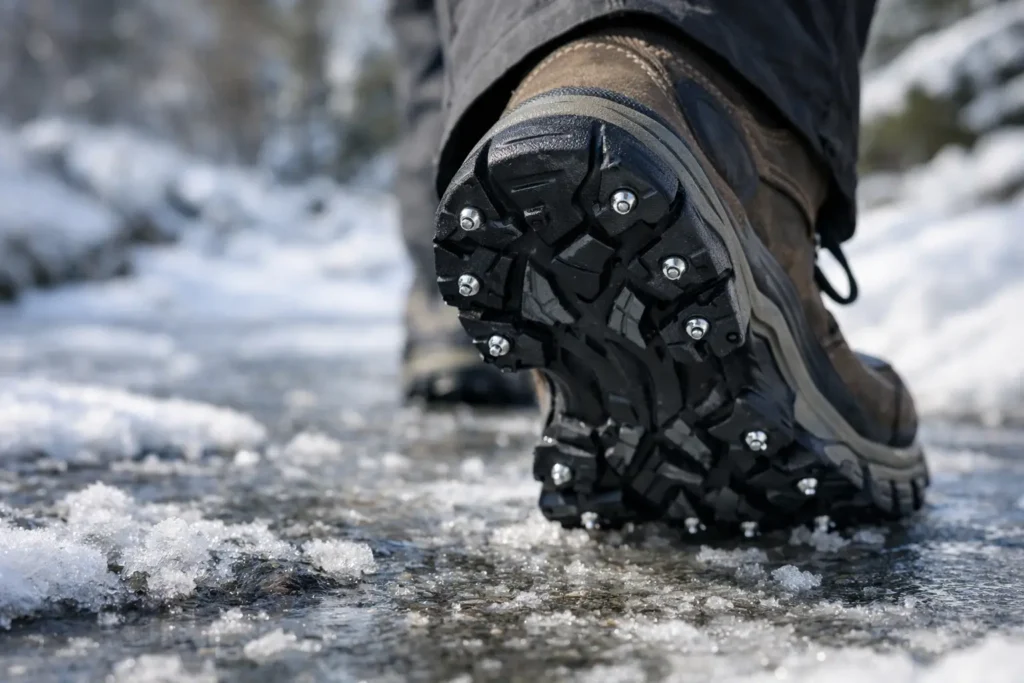
The patch of black ice is usually not in the middle of the sidewalk. It is at the curb, beside the truck, on the shaded porch step, or halfway through a dog walk when you have stopped watching every inch of ground. Shoe spikes for winter walking are built for that moment: the sudden loss of traction that can turn an ordinary step into a hard fall.
Good winter traction should not make you feel like you are walking in borrowed equipment. It should let you move naturally, keep your footing when conditions change, and stay out of your way when your day moves from the driveway to the trail, jobsite, or frozen parking lot.
Why winter walking needs real traction
Snow gets the attention, but ice causes the trouble. Packed snow can become slick under repeated foot traffic. Meltwater refreezes overnight. A light dusting hides frozen pavement, roots, rocks, and steps. Even a familiar route becomes unpredictable when temperatures bounce above and below freezing.
Ordinary boot soles help on dry ground, but rubber lugs have limits on glare ice. Once the surface is smooth and frozen, more tread alone does not create the bite needed to stop a slide. That is where metal traction points earn their place. They penetrate or engage with the surface, creating a more secure connection between your foot and the ground.
For walkers, that grip protects more than comfort. It protects knees, hips, wrists, and confidence. A slip can derail work, training, travel plans, and the simple freedom to get outside. Reliable traction makes it easier to keep moving instead of treating every icy morning as a reason to stay in.
What makes shoe spikes for winter walking work
The best traction system is not necessarily the one with the most hardware hanging under your foot. What matters is placement, point design, secure attachment, and how the system works with the shoe you already trust.
Spikes placed in key contact zones can help you grip during heel strike and toe-off, the two moments when walking traction matters most. A low-profile design also helps preserve a natural gait. You should feel planted, not perched on a bulky layer that changes your stride or catches on uneven ground.
Direct-to-sole screw-in spikes have a major advantage here. Rather than wrapping chains, coils, and rubber harnesses around the outside of a shoe, they install into the sole itself. The result is a more integrated feel with less bulk around the foot. For people who walk, work, run, hike, or move across mixed terrain, that difference can mean less fuss and less fatigue over a long day.
ICESPIKE uses this approach to turn compatible footwear into serious traction gear without forcing you into a separate over-shoe device. The goal is simple: keep the footwear you like wearing and add the grip winter demands.
Grip is only useful if it stays put
A traction device that shifts, loosens, or comes off halfway through a walk creates a new problem. Strap-on systems can be useful for occasional use, especially when you need to put traction on and take it off quickly. But their fit can vary between shoes, and rubber harnesses can stretch, slip, or feel awkward over bulky work boots.
Installed spikes are different. When properly fitted to a suitable sole, they stay where they belong. There is no chain bundle under the arch and no elastic frame creeping around the heel. That stable connection is especially valuable for outdoor workers, daily walkers, and anyone who cannot stop to adjust gear every few blocks.
Choose spikes based on where you actually walk
There is no single winter surface. The right setup depends on whether your route is mostly icy pavement, packed trails, slushy paths, steep terrain, or a mix of all four.
For neighborhood walking and errands, prioritize a low-profile configuration that grips ice without making every step feel overly aggressive. You may cross dry concrete, store entryways, and vehicle floors during the same outing. A lighter, integrated setup is often more practical than a large chain-based device designed for deep mountain snow.
For trails, woods, and uneven property, look for traction that can handle frozen dirt, slick roots, hard-packed snow, mud, and gravel. Winter hiking rarely gives you one clean surface. Durable metal points offer confidence when a trail shifts from snow-covered to exposed rock in a few steps.
For work, durability and secure installation rise to the top. Delivery drivers, utility crews, construction workers, landscapers, and others who spend hours outside need traction that supports a full shift. The right spikes should add grip without adding a heavy, clumsy feel that wears down legs over time.
For older adults and anyone returning to walking after an injury, simplicity matters. A system that is already installed on a dependable pair of boots or shoes removes one more decision from a cold morning. Still, traction is only one part of fall prevention. Choose footwear with a stable fit, take shorter steps, and use handrails whenever they are available.
Start with the right shoe or boot
Shoe spikes work best when the footwear underneath them is ready for the job. Choose a sole with enough thickness and solid material for installation. Thin minimalist soles, badly worn-out shoes, and soles with large hollow cavities may not be appropriate. When in doubt, inspect the bottom of the shoe carefully before adding hardware.
A walking shoe should also fit securely at the heel and through the midfoot. Spikes cannot correct a loose boot, poor lacing, or a shoe that lets your foot slide inside it. Secure footing starts from the ground up, but it continues through the entire fit of the footwear.
Think about your winter rotation, too. Many people get the best results by dedicating one pair of walking shoes, hiking boots, or work boots to traction duty. That keeps the setup ready when conditions turn bad and prevents the last-minute search for a strap-on device buried in a closet or car trunk.
Use winter spikes with good judgment
Metal traction gives you more control, not invincibility. Ice can still be uneven, hidden, or covered by loose snow. Slow down on steep slopes, test uncertain surfaces, and avoid assuming that every step will hold exactly the same way.
Be especially mindful on smooth indoor floors, finished wood, tile, polished concrete, and delicate surfaces. Metal points can be slippery or damaging there. If your day requires frequent transitions indoors, plan your footwear and route accordingly. This is one of the real trade-offs of any serious traction system: the grip that works outdoors is not intended for every interior surface.
Check spikes periodically for wear, damage, and tightness. Winter grit is hard on gear, and regular inspection is part of owning equipment you count on. A quick look before a long walk or work shift is far better than discovering a problem miles from home.
A better way to keep winter from shrinking your world
The purpose of traction is not to make winter feel risk-free. It is to make your next step more dependable when conditions are working against you. Whether you are walking the dog before sunrise, carrying equipment across a frozen lot, logging trail miles, or helping a parent stay active, the right spikes give ordinary footwear a tougher job description.
Do not wait for the first fall to decide that winter footing matters. Set up the shoes you already rely on, step outside with intent, and let icy ground become one less reason to stay put.